

Why Do We Have Seasons? The Secret of Earth’s Tilt
Have you ever wondered, why do we have seasons? Many people think they know the correct answer to this question. For instance, they believe the Earth is closer to the Sun in summer, and farther away in winter. However, this popular idea is completely wrong!
In fact, the Earth is closest to the Sun in January, during our cold winter. On the other hand, it is farthest from the Sun in July, during our hot summer. The distance between the Earth and the Sun changes by about 3 million miles. But this small change does not really affect our weather. Therefore, what is the real reason for the seasons? It is all about Earth’s tilt.
(Before reading further, if you want to check your general language level, feel free to try our English Level Tests page!)
The Great Space Crash
Imagine a straight line going right through the center of the Earth, from the North Pole to the South Pole. This imaginary line is called the axis. The Earth spins around this axis every day, and this spinning gives us day and night. However, the Earth’s axis does not stand straight up and down. Instead, it leans to the side.
Long, long ago, when the Earth was very young, a giant space rock named Theia hit our planet. Consequently, this huge crash knocked the Earth to the side. Since that day, the Earth has been tilted. By the way, that big crash threw a lot of dust and rocks into space. Over time, those pieces came together and formed our Moon!
Interactive Earth Tilt & Seasons Simulator
How the Tilt Makes Seasons
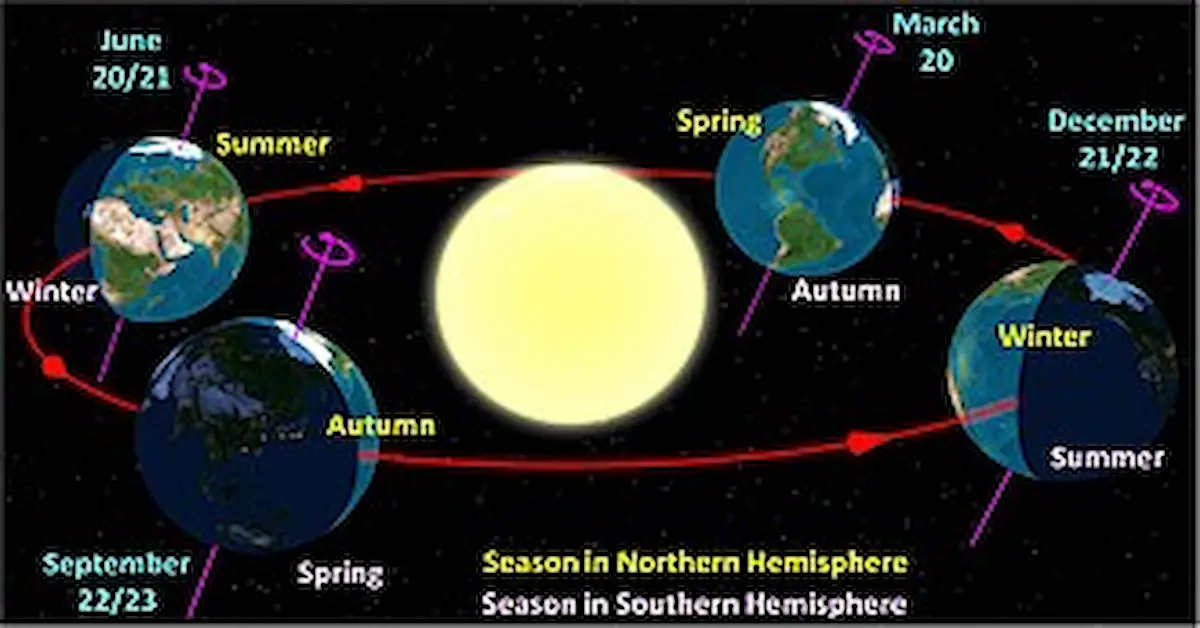
As the Earth travels around the Sun, its tilted axis always points in the same direction. Because of this, different parts of the Earth get direct sunlight at different times of the year.
- Summer (June): The top half of the Earth (the Northern Hemisphere) tilts toward the Sun. As a result, the Sun’s rays hit this part directly. The days are long, and the weather is hot.
- Winter (December): The top half of the Earth tilts away from the Sun. Therefore, the sunlight is weaker, and the days are short. This brings cold winter weather.
At the same time, the bottom half of the Earth (the Southern Hemisphere) has the opposite seasons. For example, when it is winter in New York, it is summer in Australia! Without that ancient space crash, our weather would be the same every day. Finally, thanks to Earth's beautiful tilt, we can enjoy four wonderful seasons!
(Note: After you finish this lesson, you can practice your vocabulary with our interactive English Learning Games section.)
🌐 General Resources & Further Reading
If you want to explore more about Earth's tilt, space history, and how seasons work, check out these highly recommended and trusted educational resources:
- NASA Space Place – What Causes the Seasons? An excellent, easy-to-read resource designed for English learners and students, featuring simple animations and clear explanations.
- National Geographic Education – Season An in-depth encyclopedic entry that covers weather patterns, equinoxes, solstices, and how seasons impact biodiversity on Earth.
- NASA Moon Exploration – The Lunar Gold Rush & Origin Learn more about the "Giant Impact Hypothesis" (Theia crash) and how the debris from that collision formed our Moon.
- Time and Date – Seasons: Solstices and Equinoxes A great tool to check the exact dates and times of season changes (solstices and equinoxes) for any city in the world.
- Wikimedia Commons – Earth's Seasons Multimedia The official public repository where you can find more open-source diagrams, charts, and interactive maps related to Earth's orbit.
🚀 Mega Space & Seasons Trivia
14 Master Questions • Strictly Based on the Text
Leave a Reply